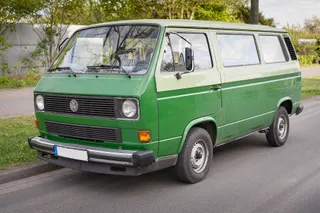
The Volkswagen Bus/Transporter (T3) (1979-1992) averages €12,967 based on 71 listings. Prices range from €1,500 to €35,000 with an average mileage of 168,826 km.
- Typical price (median): €11,999
- Typical range (middle 50%): €6,950 – €17,200
- Average price: €12,967
- Price range: €1,500 – €35,000
- Production years: 1979-1992
- Average mileage: 168,826 km
- Active listings: 71
Typical price (median)
€11,999
Listings analysed: 71
Typical price range
€6,950 – €17,200
middle 50% of listings
Full range
€1,500 – €35,000
Average: €12,967
Price History
Details
Buying guide: Volkswagen Bus/Transporter (T3)
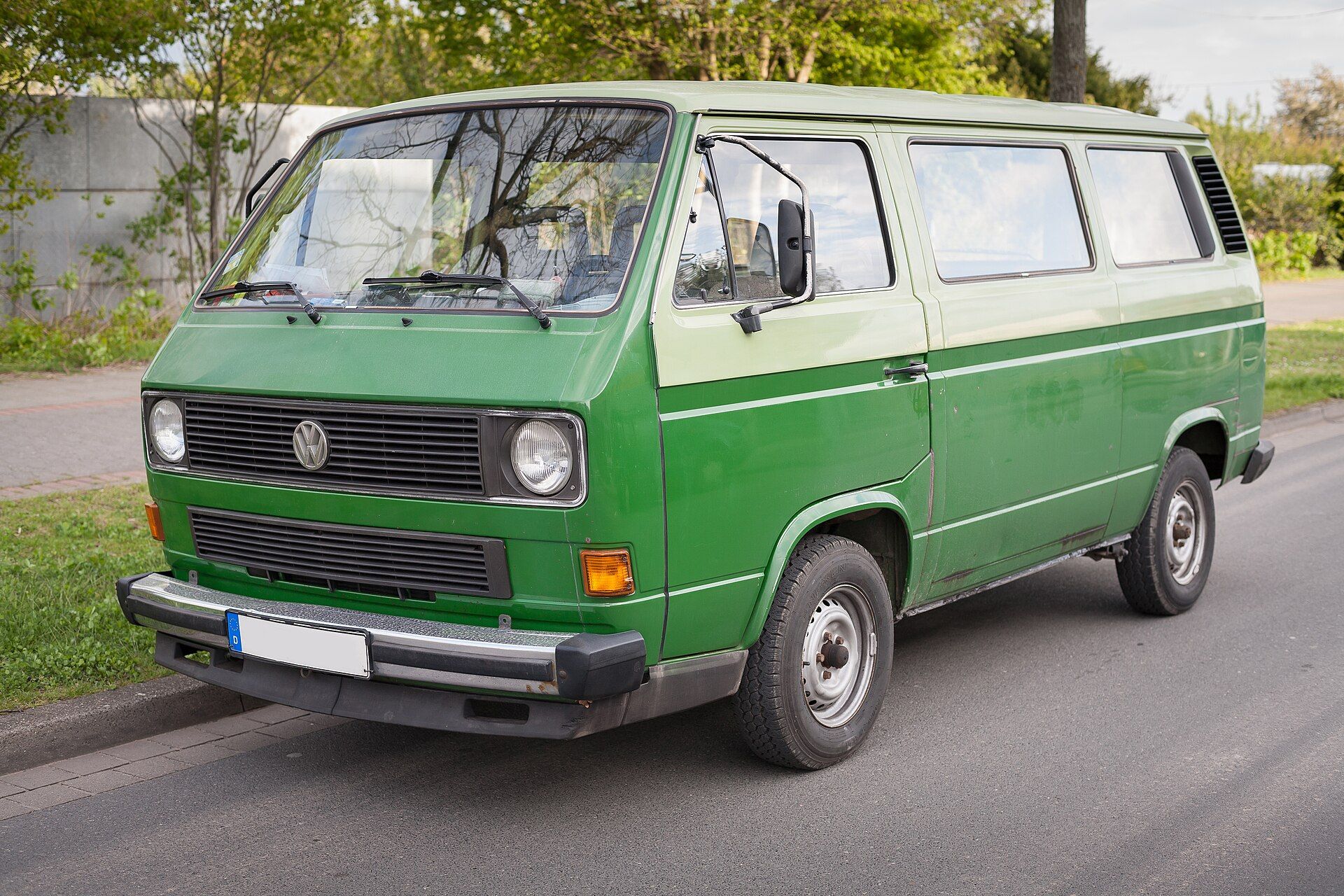
The Volkswagen T3 is the third generation of the VW Transporter, built from 1979 to 1992 and the last one with a rear engine. It is known as the T25 in the UK and the Vanagon in North America. Body styles were panel van, Kombi, bus or Caravelle, pick-up and double cab, plus the Multivan and camper vans, for example by Westfalia. Air-cooled flat-four engines were used until 1982, then water-cooled ones (Wasserboxer); inline-four diesels were added, and the four-wheel-drive Syncro followed in 1985. The mechanicals are regarded as simple, but the body rusts in many places. When buying, the state of the metalwork therefore matters more than year or mileage.
Key variants
- Air-cooled flat-four 1.6 (50 PS) and 2.0 (70 PS), 1979–1982
- Early T3s have air-cooled petrol engines. They are considered weak, the 1.6 in particular, and often use more than 15 litres per 100 km. Parts for the 1.6 are harder to find than for the later engines.
- Wasserboxer 1.9 and 2.1, from 1982
- Water-cooled flat-four petrol engines: the 1.9-litre with 60 or 78 PS among others, later the 2.1-litre with 95 PS (catalytic converter) or 112 PS. The 2.1 is the most sought-after petrol engine. With every Wasserboxer, a well-maintained cooling system is essential.
- Diesel 1.6 D, 1.7 D and 1.6 turbodiesel
- Inline fours rather than flat engines. The naturally aspirated diesels with 50 PS (1.6) and 57 PS (1.7) are slow but run without fuss if serviced regularly. The 70 PS turbodiesel pulls better, yet is considered sensitive to heat and needs careful upkeep.
- Syncro (four-wheel drive, from 1985)
- Permanent four-wheel drive with a viscous coupling instead of a centre differential; the 4WD hardware was fitted by Steyr-Daimler-Puch in Graz and about 45,500 were built. Auto Bild recommends the Syncro only if four-wheel drive is really needed, as the rear-drive van gives less trouble overall.
- Camper vans and Multivan
- Westfalia built the Joker and California models among others, and there are many conversions by other firms and by owners. The Multivan arrived in 1985. On campers, the pop-top or high roof and the cut-outs and insulation of the conversion are additional things to check.
Known weak points
- Rust in body seams, windscreen frame and door steps. The seams between the body panels are the best-known rust spot: the sealant cracks, moisture gets in and the metal rots from within. Seams smoothed over with filler, often around the rear wheel arches, hide larger damage. When the windscreen seal turns porous, the screen frame and the door steps rust and water collects in the footwell. Sills and the rear panel are affected as well. [1][2][4][5][7]
- Campers and high roofs: hidden rust caused by damp. On camper conversions the insulated outer wall around the kitchen unit rusts because the insulation holds moisture. On high roofs the seal to the body turns brittle; the roof edge and gutter then rust, and a lasting repair means taking the roof off. Leaking pop-tops let water run down to the floor, and the canvas can have holes and mould. [1][2][4][6]
- Wasserboxer: water-jacket seals, cylinder heads, cooling system. The water-cooled petrol engines are prone to leaking water-jacket seals and corroded cylinder heads. If the coolant is not renewed regularly, the cylinder head bolts corrode too. Signs are loss of coolant and oil, and bubbles in the expansion tank when the engine is warm. On water-cooled models up to 1985 the coolant pipes under the floor can also rust through. [1][2][5][8]
- Turbodiesel: cracked cylinder heads and turbo failures. The 1.6 turbodiesel is often driven at the limit of its output. Cracked cylinder heads, failed head gaskets and failed turbochargers are known faults. With the four-speed gearbox the engine runs close to its governed speed at higher road speeds; the five-speed is easier on it. On all diesels a snapped timing belt wrecks the cylinder head, so the belt change should be documented. [1][2][5][8]
- Underside: fuel tank, rear trailing arms and front axle. The fuel tank rusts on its top side, which is hard to see; a smell of fuel when filling up is a pointer. The rear trailing arms can rust through unnoticed and tear under load. At the front, ball joints, wishbone bushes, track rod ends and the radius rod mounts are often worn, and the steering rack can leak. [1][2][4][5]
- Gear change, gearbox and Syncro drivetrain. If gears no longer engage cleanly, the bushes of the gear linkage are usually worn. Oil at the bell housing points to a hardened shaft seal on the gearbox; replacing it means removing the gearbox. On the Syncro the gearbox is considered less durable, and more than 200,000 km is rare. Its viscous coupling and differential locks also fail comparatively often. [1][2][3][5]
Checklist for the viewing
- Look at every body seam all round: if a seam is no longer visible as a groove, it has been filled. Use a magnet, especially around the rear wheel arches.
- Lift the mats in the cab and at the door steps and look for damp and rust; check the lower corners of the windscreen frame and the seat belt mounting points.
- On a Wasserboxer, get the engine warm and look into the expansion tank: bubbles and loss of coolant or oil are warning signs. Ask for proof of regular coolant changes.
- On a lift, check the rear trailing arms including the spring seats, the shock absorber mounts, the coolant pipes and, as far as visible, the fuel tank for rust; test the front axle joints for play.
- On the test drive go through all gears: they must engage cleanly and the gearbox must not grind. On a Syncro, engage and release the differential locks to see that they work.
- On campers, check the pop-top canvas for holes and mould, the roof seal and gutter for rust bubbles, and the outer wall around the kitchen and fridge for rust.
Sources
- [1] VW T3 Bulli: Kaufberatung, Check, Preis, kaufen, Motor — AUTO BILD
- [2] VW T3 im Gebrauchtwagen-Check — AUTO BILD
- [3] Gebrauchtwagen-Check VW Bus T3 syncro — AUTO BILD
- [4] VW T3 kaufen: Die besten Tipps in unserem Ratgeber — AUTO ZEITUNG
- [5] Misc tips and tricks buyers guide (VW T25/T3 Tech Wiki) — Club 80-90
- [6] Volkswagen T25 'Wedge' camper van buying guide — Practical Motorhome
- [7] Kaufberatung Quader-Bulli VW T3 — AUTO BILD KLASSIK
- [8] Gebrauchtwagen-Test: VW Bus T3 Caravelle (1979-1992) — AUTO BILD
- [9] VW T3 — Wikipedia (deutsch)
Researched: 22 November 2026
Price Distribution
25th Percentile
€6,950
Median (50%)
€11,999
75th Percentile
€17,200
90th Percentile
€25,000
The median shows the middle price - 50% of listings are below, 50% above.
Mileage and Price
Correlation
No data
Mileage Range
1%
Price Trend
+€10/10k km
Relationship between mileage and price.
Market Activity
Current
71
Average
72
Maximum
118
Trend
stable
Number of listings over time. More listings mean greater selection for buyers.
Series Comparison: Bus/Transporter
| Model | Average | Deviation | Listings |
|---|---|---|---|
| T4 | €7,107 | -45% | 68 |
| T5 | €10,495 | -19% | 68 |
| T3 | €12,967 | - | 71 |
| T6 | €21,951 | +69% | 68 |
| T2 | €24,518 | +89% | 66 |
| T6.1 | €31,084 | +140% | 66 |
| T7 | €42,727 | +230% | 52 |
| T1 | €46,168 | +256% | 62 |