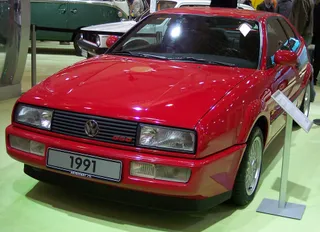
The Volkswagen Corrado (Corrado) (1988-1995) averages €14,011 based on 63 listings. Prices range from €3,300 to €34,890 with an average mileage of 169,273 km.
- Typical price (median): €12,900
- Typical range (middle 50%): €9,575 – €16,944
- Average price: €14,011
- Price range: €3,300 – €34,890
- Production years: 1988-1995
- Average mileage: 169,273 km
- Active listings: 63
Typical price (median)
€12,900
Listings analysed: 63
Typical price range
€9,575 – €16,944
middle 50% of listings
Full range
€3,300 – €34,890
Average: €14,011
Price History
Details
Buying guide: Volkswagen Corrado (Corrado)
The Volkswagen Corrado is a 2+2 sports coupé with a large tailgate, built by Karmann in Osnabrück from 1988 to 1995; about 97,500 were made. Its mechanical parts are closely related to the Golf, and its trademark is a rear spoiler that rises automatically at speed. Engines ranged from four-cylinders with 115 to 160 PS to the six-cylinder VR6. Car magazines still praise the way it drives. Many cars have been tuned, lowered or repaired after accidents, so unmodified examples with a documented history have become scarce. Mechanical parts are mostly easy to obtain, while Corrado-specific body panels and interior trim can be hard to find.
Key variants
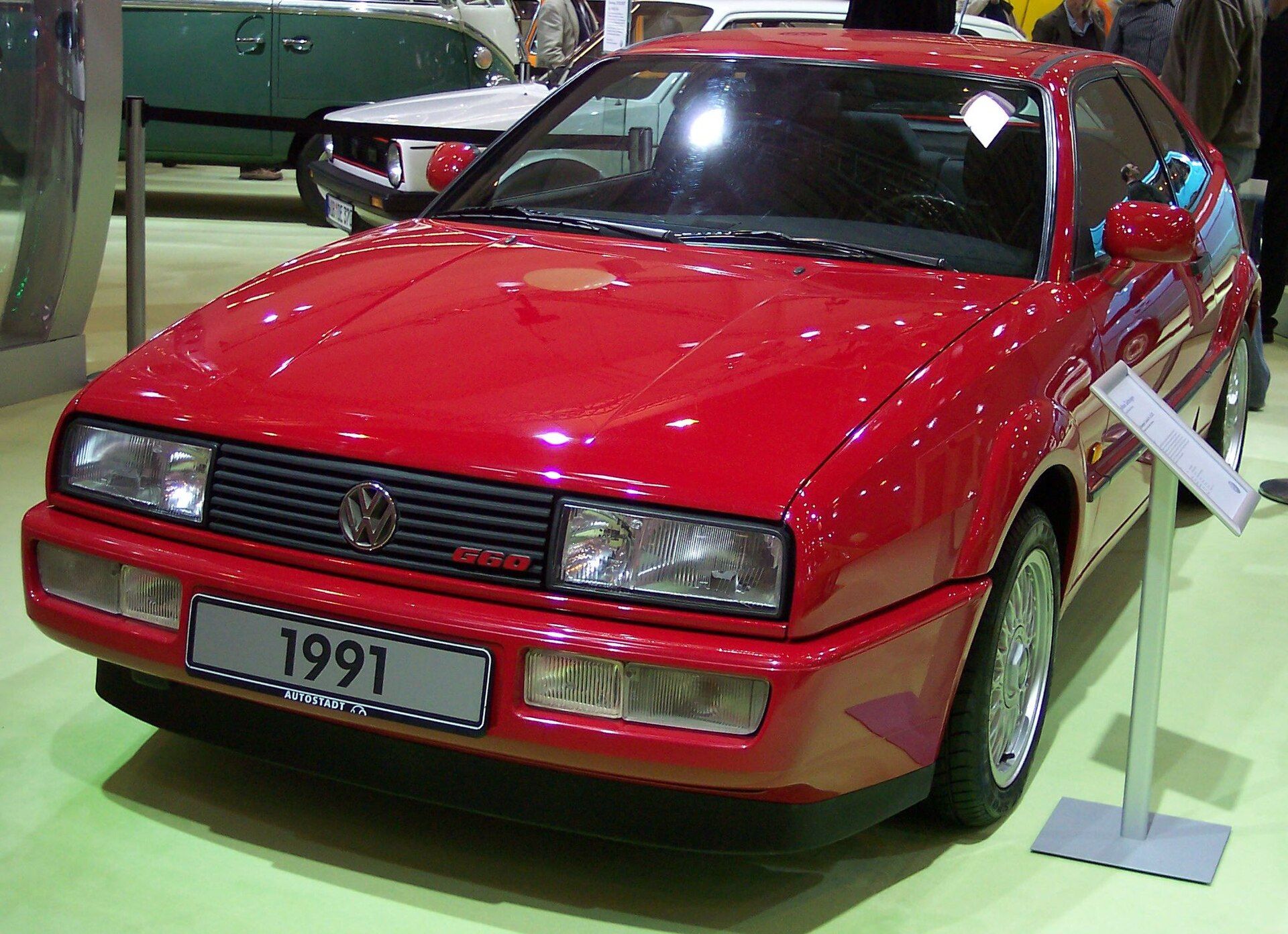
- G60 (1.8 supercharged, 160 PS)
- The engine the Corrado was launched with in 1988, built until 1993. The eight-valve unit is boosted by a scroll-type supercharger (G-Lader) that gives strong pull but needs regular maintenance and, sooner or later, a rebuild. The supercharger's condition and history are decisive when buying.
- 1.8 16V (about 136 PS)
- Naturally aspirated 16-valve engine, offered from 1989 and replaced by the 2.0 16V in 1992. Without a supercharger it needs less care than the G60, but it has a cam belt whose replacement should be documented.
- 2.0 16V (136 PS)
- Successor to the 1.8 16V from 1992, with a catalytic converter. According to Auto Zeitung it costs hardly more to run than the eight-valve 2.0 yet is clearly livelier. It has neither a supercharger nor timing chains.
- 2.0 (eight-valve, 115 PS)
- Entry-level engine from 1993, shared with the Golf Mk3 GTI and also available with an automatic gearbox. The least powerful Corrado is considered tame and takes away much of the coupé's liveliness.
- VR6 (2.9 litres, 190 PS)
- Sold in Europe from autumn 1991 (later in some markets) with 2.9 litres and 190 PS, and in North America as the SLC with 2.8 litres. The six-cylinder is considered robust in standard form but needs regular oil changes; its camshafts are chain-driven. An automatic gearbox was available.
Known weak points
- G60 supercharger (G-Lader). The scroll supercharger is the main risk on a G60. Its seals and internals wear; auto motor und sport reports that units often gave up after about 80,000 km even without tuning, and more often on cars with altered supercharger gearing. Oil in the pipe to the intercooler indicates that a rebuild is due. Wear caught early can be repaired by a specialist; without proof of an overhaul, one should be planned for. [1][2][3][4]
- VR6 timing chains. Rattling from the timing chain area points to worn guides or tensioners. British buying guides cite mileages from roughly 80,000 to 100,000 miles (130,000 to 160,000 km). According to Auto Zeitung, a faulty oil pump can produce excessive oil pressure, which presses the tensioner too hard against the chain and accelerates wear; if only the tensioner is then replaced, the cause remains. [3][4][5][6]
- Cam belt, valve guides and ignition. All four-cylinder engines have a cam belt that British sources say is due about every five years or 40,000 miles (roughly 65,000 km). On the 16V, blue smoke after starting suggests worn valve guides, and an uneven idle often the idle stabilisation valve. Also mentioned are rough running caused by the connector on the ignition distributor and leaking thermostat housings. [3][4][5][6]
- Rust despite galvanised panels. The Corrado rusts less than many contemporaries but is not immune. Check the sills including their ends (blocked drain channel) and jacking points, the wheel arches, especially lips rolled for wider wheels, the area around the fuel filler, door bottoms, front valance, windscreen surround and the underside of the bonnet. At the filler neck the rust starts from inside the wheel housing and goes unnoticed for a long time. [3][4][5][6]
- Electrics, sunroof and rear spoiler. Window lifts, central locking, the headlight switch and the heating and ventilation controls fail with age; if the engine will not start, the ignition/starter switch is often to blame. The electric sunroof suffers from failures of its cable mechanism. The rear spoiler can seize, though cleaning and greasing is often enough. Failed ABS sensors or trigger rings keep the warning light on. [1][2][3][4][5][6]
- Damp interior and heater matrix. Wet carpets in the footwells often point to a leaking heater matrix. Replacing it is laborious because the dashboard has to be removed. Other possible causes are worn door seals or leaking door membranes and blocked drains at the bulkhead. [4][6]
Checklist for the viewing
- G60: ask for paperwork on supercharger maintenance or a rebuild, check the pipe to the intercooler for oil and ask whether the supercharger drive has been modified.
- VR6: start the engine from cold and listen for chain rattle; ask for invoices covering chains and tensioners and, if possible, have the oil pressure measured.
- Four-cylinders: ask for proof of the date and mileage of the last cam belt change, and watch for blue smoke on start-up and a steady idle.
- Check sills, jacking points, wheel arch lips, the fuel filler area, door bottoms and windscreen surround for rust; uneven panel gaps and missing factory stickers point to accident repairs.
- Try every electrical function: windows, sunroof, central locking, lights, heater controls and the rear spoiler via its switch; the ABS light must go out after starting.
- Lift the carpets in the footwells and check for damp; look at seat bolsters, door handles, headlining and the trim around radio and heater controls for wear and breakage.
Sources
- [1] VW Corrado Kaufberatung: VW Golf macht auf Sport-Coupé — auto motor und sport / Motor Klassik
- [2] VW Corrado: Der G-Lader macht das Sportcoupé besonders — Auto Bild Klassik
- [3] VW Corrado kaufen: Ratgeber — Auto Zeitung Classic Cars
- [4] Buying Guide: Volkswagen Corrado — Hagerty UK
- [5] Used Volkswagen Corrado (1989-1995) buyer's guide: an overlooked gem — Auto Express
- [6] Volkswagen Corrado buying guide, history and model review — Octane Magazine
Researched: 22 November 2026
Price Distribution
25th Percentile
€9,575
Median (50%)
€12,900
75th Percentile
€16,944
90th Percentile
€22,000
The median shows the middle price - 50% of listings are below, 50% above.
Mileage and Price
Correlation
moderate
Mileage Range
-60%
Price Trend
-€571/10k km
Relationship between mileage and price.
Market Activity
Current
63
Average
87
Maximum
140
Trend
stable
Number of listings over time. More listings mean greater selection for buyers.
Seasonal Price Patterns
Cheapest Month
Nov
€14,491
Most Expensive Month
Aug
€16,675
Price difference between cheapest and most expensive month: €2,184. The timing of purchase can significantly affect the price.